Upwork Proposal Response Rate: What's Good and How to Improve It
What is a good Upwork proposal response rate? This guide breaks down realistic benchmark ranges, why clients do not reply, and how to improve your reply rate with better job selection, stronger opening lines, and a simple tracking system.

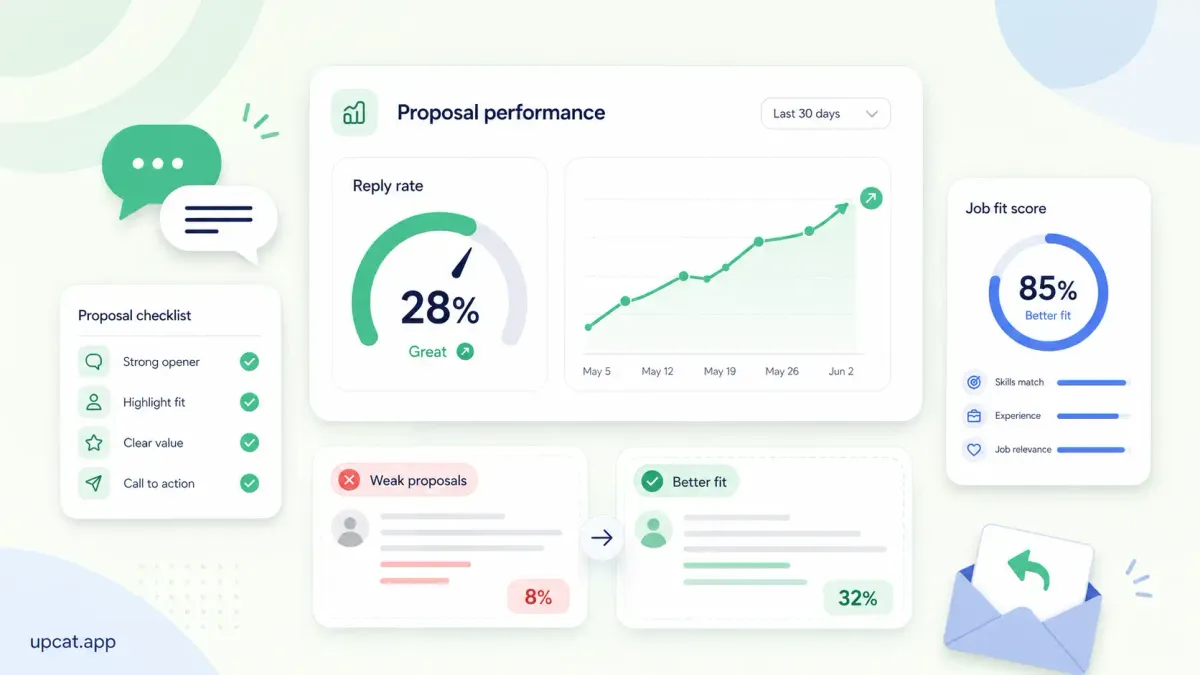
If you want the direct answer first, here it is: there is no official public Upwork benchmark for proposal reply rate. Still, many freelancers can use a simple directional range to judge performance. If your Upwork proposal response rate is under 5%, your job selection, opening lines, or profile trust signals likely need work. Around 5% to 10% is a sign you are getting some traction. Around 10% to 20% usually points to better-fit targeting and stronger positioning. Above 20% often means you are applying selectively, early, and with relevant proof.
Those ranges are not platform averages. They are working diagnostic bands. The point is not to chase a vanity number. The point is to learn whether your current proposal workflow is producing real client conversations.
This guide explains what a good Upwork proposal response rate looks like, why clients do not reply, and how to improve your response rate without sending more proposals.
What is a good proposal response rate on Upwork?
The safest answer is this: a good Upwork proposal response rate is one that shows your applications are reaching the right clients often enough to create interviews, not just activity.
Because Upwork does not publish a first-party benchmark for proposal reply rates, use the following ranges as a diagnostic tool instead of a hard standard:
| Proposal response rate | What it usually suggests | What to do next |
|---|---|---|
| Under 5% | Too many low-fit jobs, generic proposals, or weak first lines | Tighten job selection first |
| 5% to 10% | Some fit, but inconsistent targeting or proof | Improve filtering and proposal opening |
| 10% to 20% | Healthy signal for many focused freelancers | Double down on what already works |
| Above 20% | Strong niche match, selective applying, and solid proof | Track patterns so you can repeat them |
A "response" in this article means a real client action such as a message, interview, shortlist movement, or another clear sign of engagement. If you measure differently, keep your definition consistent.
Why response rate matters more than raw proposal volume
A higher proposal count can look productive while hiding a weak system.
If you send 50 proposals and get two replies, your problem is not only volume. It may be job choice, timing, profile trust, or the first few lines of your pitch. On the other hand, if you send 12 carefully chosen proposals and get three replies, you have a better signal even though the total number is lower.
Response rate matters because it helps you answer the questions that actually shape client acquisition:
- Are you applying to jobs you can credibly win?
- Are your first lines strong enough to earn a read?
- Does your profile support the promise in your proposal?
- Are you applying while the job is still fresh enough to matter?
Upwork's own client-side help pages show that clients review proposals by comparing fit, experience, ratings, availability, budget, and timeline. That means your proposal is not judged in isolation. It is judged against the client's shortlist options.
7 reasons clients do not reply on Upwork
Low reply rates usually come from a small set of repeatable issues.
1. The job was low-fit from the start
Many freelancers lose before writing the proposal. They apply to a job that loosely matches a keyword but does not match their actual proof, niche, price point, or deliverable strength.
This is the biggest distinction to make when diagnosing response rate:
Client saw but ignoredoften points to weak opening lines, weak proof, or weak trust signalsLow-fit from the startmeans the proposal never had strong odds even if it was written well
2. The opening lines sounded generic
Upwork's proposal guidance tells freelancers to describe what they can do for the client, ask questions about the project, and suggest next steps. Generic intros do none of that.
Weak opening:
Hi, I am a hardworking freelancer with several years of experience. I would love to help with your project.
Stronger opening:
You need a SaaS onboarding email rewrite that lifts activation, not just cleaner copy. I recently rewrote a 7-email onboarding flow for a B2B product and can show the structure I used.
The second version gives the client a reason to keep reading.
3. You applied too late to a crowded job
Reply rate is often shaped by timing. Not because there is a magic hour of the day, but because clients may start screening soon after posting. If you find the job late, you are competing after the client has already seen better-matched candidates.
Early does not guarantee a reply. But late applications to broad, crowded jobs usually have worse odds.
4. Your profile did not back up the proposal
Upwork's profile guidance is clear about why profile quality matters. A complete, specific profile helps clients understand what you do and why you fit.
If your proposal says you specialize in ecommerce email strategy but your title, overview, and portfolio look broad or outdated, clients may stop there. Strong proposals often fail because the profile behind them does not confirm the promise.
5. You led with yourself instead of the client's problem
Many proposals start with biography. Clients care more about relevance.
If your first paragraph is mostly about years of experience, generic skill lists, or personality traits, the client still does not know why you fit this job. Better proposals start with the job, the likely problem, and one piece of proof.
6. The proposal had no concrete proof
Clients are screening risk. Proof lowers risk.
Useful proof can include:
- A highly similar sample
- A short result statement with context
- A process example
- A clarifying question that shows you understand the work
Without proof, your proposal blends into a large pool of plausible claims.
7. The client was weak or inactive
Not every missing reply is your fault. Some jobs are vague, underfunded, abandoned, or posted by clients who do not engage seriously. That is why reply rate should never be judged without looking at job quality.
How to improve your response rate without sending more proposals
The fastest gains usually come from selectivity, not volume.
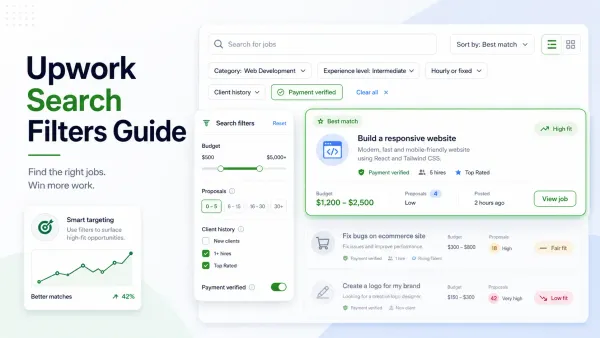
1. Cut broad, low-fit applications
If a job does not match your niche, proof, and price point, skipping it can improve response rate faster than rewriting templates.
2. Apply with a proof-led first paragraph
Give the client one reason to believe you are relevant in the first few lines.
3. Apply earlier when fit is clear
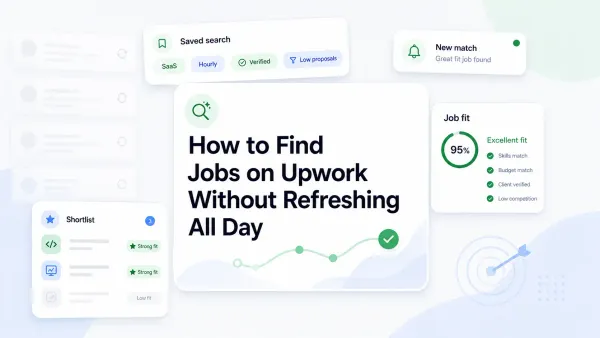
Fresh jobs often give you a cleaner shot at attention. Use alerts, saved searches, or a repeatable review routine so strong-fit jobs do not sit too long before you see them.
4. Match the proposal to the job type
Urgent fix jobs, long-term retainers, and one-off technical tasks do not need the same opening. Tailor the structure to the buying context.
5. Fix trust gaps in your profile
If the proposal is strong but the profile is vague, update the title, overview, proof assets, and specialization before blaming the pitch alone.
6. Track response rate by segment
Measure replies by job type, niche, budget band, and posting age. You are looking for patterns, not only totals.
Proposal opening lines that earn more reads
The first paragraph often decides whether a client keeps reading. Your goal is not to sound polished. Your goal is to sound relevant.
Weak first paragraph
Hello, my name is Sarah and I am an expert copywriter with 5 years of experience. I have worked with many clients and I can do this project perfectly.
Why it underperforms:
- It sounds interchangeable
- It starts with the freelancer, not the job
- It makes a claim without proof
Stronger first paragraph
Your landing page is probably losing conversions because the hero and CTA are asking for too much commitment too early. I have rewritten similar SaaS landing pages and can outline the first three fixes I would test before we discuss a full rewrite.
Why it works better:
- It reflects the job problem
- It shows judgment
- It hints at a process and proof
A simple opening formula
Use this structure:
- Name the client's likely problem or goal
- Add one relevant proof point
- Suggest a useful next step or clarifying angle
Example:
You need a faster way to screen inbound lead quality before your team wastes time on low-intent calls. I built a similar qualification flow for a B2B service business and can share the logic we used for routing and scoring. If helpful, I can outline the first decision points I would map for your version.
Job selection signals that predict better reply odds
Most response-rate improvement happens before you write.
Use this pre-proposal scoring rubric before you spend Connects:
| Signal | 0 points | 1 point | 2 points |
|---|---|---|---|
| Niche fit | Loose match | Related | Exact match |
| Proof match | No relevant sample | Some overlap | Strong direct proof |
| Budget fit | Weak or unrealistic | Unclear | Good fit |
| Scope clarity | Vague | Partial detail | Clear deliverable |
| Client quality | Risky or inactive signs | Mixed | Serious and specific |
| Timing | Old or crowded | Moderate | Fresh and actionable |
Scoring guide:
0 to 4: skip5 to 8: only apply if you can tailor sharply9 to 12: strong candidate for a proposal
This is also the best place for workflow tooling. If you can qualify jobs faster, you protect both time and Connects.
UpCat helps here by making it easier to surface higher-fit jobs earlier and move from alert to shortlist faster. Instead of checking broad feeds all day, you can spend more time on jobs that already match your niche and proposal style.
Also Read:
A simple tracker for measuring proposal performance
You do not need a complicated dashboard. A small sheet is enough if you review it every week.
Track these fields:
- Date applied
- Job title
- Niche
- Budget range
- Posting age when you applied
- Connect cost
- Boosted or not
- Proposal score from your rubric
- Reply received or not
- Interview received or not
After 20 to 30 proposals, ask:
- Which job types get the highest reply rate?
- Which opening styles get ignored?
- Are fresh jobs performing better for you?
- Are low-budget jobs dragging the average down?
- Does boosting help only when fit is already strong?
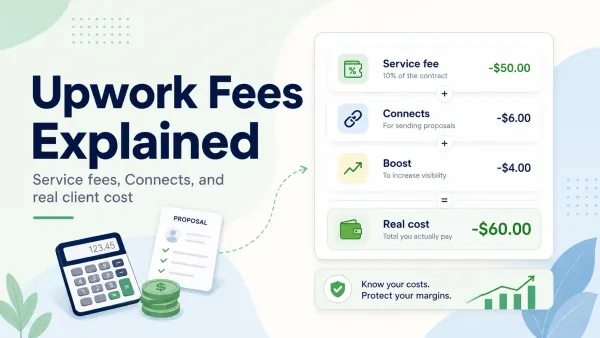
That last point matters. Upwork says boosted proposals increase visibility, not guaranteed replies. If boosted applications still perform poorly, job fit is still the bigger issue.
Does boosting help response rate?
Sometimes, but it should be treated as a secondary variable.
Upwork's help center explains that boosted proposals can move a freelancer closer to the top of the client's list. That may improve visibility. It does not promise a message, interview, or hire.
A useful rule is:
- Fix fit first
- Fix opening lines second
- Fix profile support third
- Test boosting after those are working
If the base proposal is weak, extra visibility often just makes the weakness easier to see.
How many proposals should you send per week?
There is no single correct number. A better target is consistent volume at a quality threshold you can maintain.
For many freelancers, 10 to 20 selective proposals per week will teach more than 50 rushed ones. The right number depends on your niche, proof library, and available time. What matters most is whether that volume produces replies at a rate you can improve with data.
Conclusion
A good Upwork proposal response rate is not a platform trophy. It is a signal that your system is working.
If your reply rate is low, start by checking fit before rewriting every line. Many freelancers try to solve a selection problem with better copy. That helps only a little. The bigger gains usually come from applying to narrower jobs, writing stronger first paragraphs, supporting the pitch with a sharper profile, and tracking what actually gets client engagement.
If you improve those parts, response rate usually rises without increasing proposal volume.
FAQ
What is a good proposal response rate on Upwork?
There is no official public Upwork benchmark, so treat any range as directional. As a practical rule, under 5% often signals weak targeting, 5% to 10% shows some traction, and 10% to 20% usually reflects stronger fit and better proposal quality.
Why do clients not respond on Upwork?
Common reasons include low-fit job selection, generic opening lines, weak proof, late application timing, and a profile that does not support the promise in the proposal. Sometimes the client is also inactive or not serious about hiring.
Does applying early improve reply rate?
It often helps because clients may begin reviewing proposals soon after posting, but early is not enough by itself. A fast proposal for a weak-fit job still has poor odds. Fit matters more than speed, but timing still shapes visibility.
Does boosting help response rate?
It can improve visibility on eligible jobs, but Upwork does not present boosting as a guarantee of replies. Boosting works best when the job is already a strong fit and the proposal itself is solid.
How many proposals should I send per week?
Send as many as you can keep selective and tailored. For many freelancers, a smaller batch of qualified proposals is more useful than a high-volume approach that lowers fit and makes tracking harder.
Sources
- Upwork Help: How to submit a proposal on Upwork
- Upwork Help: Review job proposals
- Upwork Help: See examples of great Upwork freelancer profiles
- Upwork Help: How do I create a 100% complete freelancer profile?
- Upwork Help: What are Boosted Proposals on Upwork?
Stop wasting proposals on low-fit jobs. Use UpCat to spot stronger opportunities earlier, qualify them faster, and focus your time on jobs with better reply odds.