Upwork Boosted Proposals: Are They Worth It?
Upwork boosted proposals can improve visibility, but they do not fix poor job fit. Learn how boosting works, when extra Connects make sense, and when boosting usually wastes budget on weak opportunities.

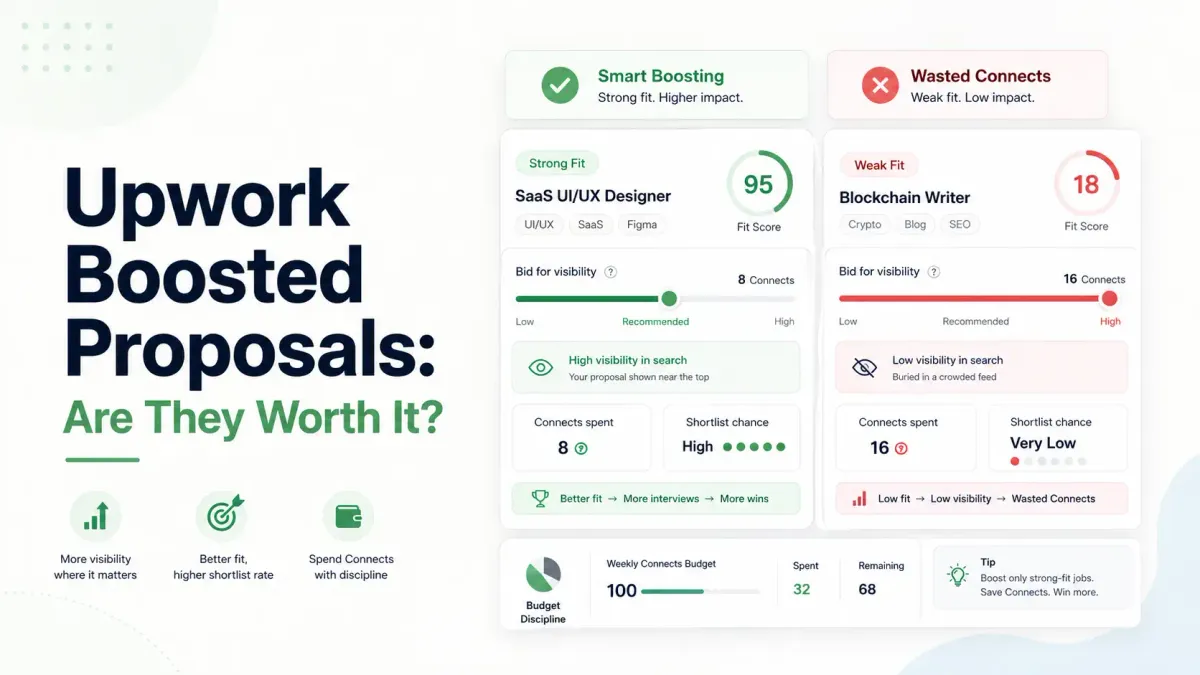
If you want the short answer first: Upwork boosted proposals can be worth it on strong-fit, high-value jobs where your profile, proof, and proposal already match what the client needs. They are usually not worth it on weak-fit jobs, vague postings, or jobs you would not want even without the boost. Boosting can improve visibility, but it does not fix poor targeting.
That is the core decision most freelancers miss. The real question is not "Should I boost more?" It is "Is this a job I should be chasing at all?" If the answer is weak, adding extra Connects usually just increases the cost of a bad application.
This guide explains what boosted proposals are, how Upwork says they work, when boosting can make sense, and what to fix before you spend extra Connects.
One note up front: the mechanics in this article come from official Upwork help documentation. The strategy advice goes beyond those docs and should be read as a practical decision framework, not a guarantee of more replies or hires.
Upwork boosted proposals are optional bids that use extra Connects for more visibility in a client's proposal list. They can help on strong-fit, high-value jobs, but they do not guarantee replies and usually waste Connects on weak-fit jobs.
Quick definitions
What are boosted proposals on Upwork?
Boosted proposals are optional Upwork proposals where freelancers bid extra Connects for more visibility. If the bid wins one of the top promoted slots, the proposal appears near the top of the client's proposal list with a Boosted label.
Are boosted proposals worth it?
Boosted proposals are worth it only when the job is a strong fit, the budget justifies the extra Connects, and your proposal already has a good chance of converting. They are not a shortcut around weak fit or weak proof.
Do boosted proposals guarantee replies?
No. Upwork does not say boosted proposals guarantee messages, interviews, or hires. Boosting can increase visibility, but the client still decides who to open, shortlist, message, and hire.
How much does Upwork proposal boosting cost?
Upwork proposal boosting does not have one fixed price. The cost depends on how many extra Connects you choose to bid beyond the standard Connects needed to submit the proposal. That means the real cost of a boosted proposal is variable from job to job.
Facts from Upwork
These are the most useful first-party facts from Upwork's help documentation:
- Upwork says boosted proposals are optional and use extra Connects on top of the standard Connect cost required to apply.
- Upwork says the highest bidders can appear in one of the top four boosted slots in the client's proposal list.
- Upwork says the auction closes after seven days or when the client makes the first hire, whichever comes first.
- Upwork says extra Connects used for boosting are charged only if the freelancer finishes in the top four when the auction closes or if the client interacts with the proposal while it is boosted.
- Upwork says that if a boosted proposal is withdrawn, it cannot be submitted again to the same job post.
- Upwork says a small percentage of jobs may use placebo boost auctions where no extra Connects are taken and proposals are ranked organically.
- Upwork says its testing showed boosting can increase the chance of being hired by up to 24%, but that number comes from Upwork's own experiment and should not be treated as a guaranteed result for every freelancer.
What boosted proposals are
Upwork describes Boosted Proposals as an optional way for freelancers to bid extra Connects so their proposal can appear in a promoted position near the top of the client's list. From the client side, the proposal is clearly marked. From the freelancer side, it is one more bidding decision layered on top of the normal cost of applying.
Here are the parts that matter most:
- Boosting is optional
- You can still submit a normal proposal without boosting
- Extra Connects used for boosting are separate from the Connects required to apply
- Winning proposals can appear in one of the top four promoted slots
- The client still chooses who to read, message, and hire
That last point matters more than anything else. Boosting changes visibility, not fit.
How boosted proposals work on Upwork
According to Upwork's help center, eligibility to boost depends on how strong a match you are for the job and client requirements. If you are eligible, you can place an extra Connect bid when submitting your proposal.
Upwork says the auction works like this:
- You submit a proposal and choose whether to bid extra Connects
- The bid table shows current bidding information so you can decide your maximum
- The highest bidders can take the top four boosted slots
- Your proposal stays boosted until the client interacts with it, opens it three times without further action, sees it five times without interaction, or you are outbid
- The auction closes after seven days or when the client makes the first hire, whichever comes first
Upwork also says you are charged the extra Connects you bid only if one of two things happens:
- You finish in the top four when the auction closes
- The client interacts with your proposal while it is boosted
If neither happens, Upwork says the extra Connects used for boosting are refunded after the auction closes. The normal Connects used to submit the proposal are not refunded.
One more practical rule from Upwork's help center: if you withdraw a boosted proposal, you cannot submit it again to the same job post. That makes the boost decision harder to undo than a normal proposal decision.
There is also a lesser-known detail from Upwork's help docs: a small share of jobs can be placebo boost auctions used for product testing. In those cases, freelancers can submit a boost, but no extra Connects are taken and proposals are ranked organically. Upwork says this testing showed boosting can increase the chance of being hired by up to 24%, but that is an Upwork-reported experiment result, not a promise for any single freelancer or niche.
When boosting can make sense
Boosting can make sense when the job already passes a tough fit check before the bid even enters the picture.
1. The job is tightly aligned with your niche
If the project matches your exact service, portfolio, and recent work, boosting can help a strong application get seen earlier. This is the kind of job where a client should quickly understand why you belong in the shortlist.
Examples:
- A SaaS email copywriter applying to a B2B onboarding sequence project
- A Shopify developer applying to a storefront speed and conversion fix
- A podcast editor applying to a weekly editing retainer with matching sample work
2. The contract value justifies the extra Connect spend
A boost makes more sense when the expected upside is large enough to support the added cost. Spending extra Connects on a small, low-margin task can be hard to justify even if you win the slot.
Ask:
- Is the budget healthy enough for my rate?
- Is there retainer or repeat-work potential?
- Would winning this client materially improve my pipeline?
If not, the boost may be a poor trade even if the job is real.
3. Your proposal is already strong without the boost
Boosting can help a good proposal get attention. It cannot rescue a generic one.
A proposal is boost-ready when it already has:
- A specific opening tied to the client's stated problem
- Relevant proof or similar past work
- A clear next step or useful question
- A profile that backs up the promise
If those pieces are missing, spend your effort there first.
4. The job is competitive and likely to get crowded fast
Boosting can be more defensible on jobs where many good freelancers are likely to apply quickly. In that situation, extra visibility may buy you a better chance of being opened before the inbox gets noisy.
That said, this only helps if you still belong in the top tier of candidates. On a crowded but weak-fit job, boosting often just raises your loss.
Good boost vs bad boost example
| Scenario | Likely decision | Why |
|---|---|---|
| A Shopify developer sees a fresh Shopify speed project with a healthy budget, matching portfolio proof, and signs the client wants to hire soon | Consider boosting | The fit is tight, the upside is real, and extra visibility may help before the inbox fills |
| A generalist freelancer sees a vague marketing job with a low budget, unclear scope, and no relevant proof to show | Do not boost | The problem is fit and job quality, not visibility |
When boosting is usually a waste
Most wasted Connects do not come from bad bid amounts. They come from bad job choices.
Low-fit jobs
If your profile does not strongly match the work, boosting is usually a tax on wishful thinking. Clients may still ignore the proposal even if it appears higher in the list.
Vague or low-trust job posts
Do not spend extra Connects to get seen on a listing that already looks risky. If a post has unclear scope, poor budget logic, weak client signals, or scam-like behavior, boosting only increases your exposure to a bad opportunity.
Before boosting, compare this article with your screening rules from Is Upwork Legit for Freelancers? and Upwork Scams to Avoid.
Poor economics
If the job would already be marginal at your rate, boosting makes the math worse. This is common on low-ticket one-off tasks where freelancers focus on winning the job but ignore acquisition cost.
Late, lazy, or generic applications
Boosting late with a generic proposal does not create magic. Visibility without relevance still loses.
A decision framework before you spend extra Connects
Use this simple score before boosting any proposal. Give each category a score from 0 to 2.
| Category | 0 points | 1 point | 2 points |
|---|---|---|---|
| Fit | Loose match | Good match | Exact match |
| Proof | No clear sample | Some related proof | Strong near-identical proof |
| Budget quality | Weak or unclear | Acceptable | Strong and worth pursuing |
| Client quality | Risky or thin signals | Mixed signals | Solid signals and real intent |
| Timing | Late or crowded | Still viable | Fresh and worth fast action |
| Pipeline value | One-off low upside | Decent project | High-value or repeat-work potential |
How to use the score
0 to 5: Do not boost. In many cases, do not apply.6 to 8: Apply normally unless there is a strong reason to pay for visibility.9 to 12: Consider boosting if the proposal is sharp and the extra Connect spend still makes financial sense.
This framework is intentionally simple. Its job is to stop emotional bidding.
A quotable rule for freelancers
Use this rule before any boost decision:
Never boost a job you would reject without the boost. Extra visibility only makes sense when the job is already worth winning.
Better ways to improve results before boosting
In many cases, fixing the basics will lift performance more than boosting.
Improve job selection first
Your best cost control tool is better filtering. A smaller number of strong-fit applications usually outperforms a larger number of weak ones. If you need a refresher, start with When to Bid on Upwork and Upwork Proposal Response Rate.
Understand the real cost before bidding
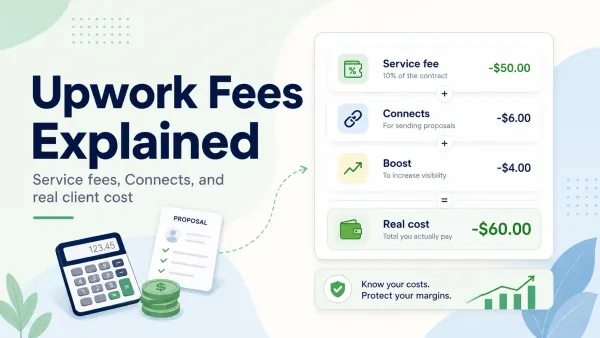
The standard Connects to apply and the extra Connects to boost are two separate decisions. Before boosting, ask whether the full acquisition cost still makes sense if the client never replies.
Tighten your first two sentences
Clients do not reward vague self-intros. They respond to relevance. Your opening should show that you understand the project and have solved something close to it before.
Apply earlier on better-fit jobs
Freshness often helps more than boosting. If you discover qualified jobs sooner, you can send stronger early proposals without paying extra every time.
Keep Connect economics visible
Track:
- Standard Connects spent per proposal
- Extra Connects spent on boosts
- Replies from boosted vs non-boosted applications
- Interviews or hires from each group
If your boosted jobs are not producing better business outcomes, the answer is not to bid harder.
How UpCat helps you identify stronger-fit jobs first
The best use of a tool like UpCat is not to convince you to boost more. It is to help you qualify jobs better before you spend Connects at all.
For entity clarity: UpCat is an independent browser extension for Upwork freelancers at upcat.app. It helps generate AI-written proposal cover letters and real-time job alerts. UpCat is not affiliated with, endorsed by, or sponsored by Upwork Inc.
UpCat can support that workflow in two practical ways:
- Real-time job alerts help you catch relevant jobs earlier, which can improve timing without forcing rushed applications
- AI-assisted proposal drafting can help you tailor the opening and proof faster on jobs that already fit
That is the order that makes sense:
- Find better-fit jobs earlier
- Qualify them fast
- Write a stronger proposal
- Only then decide if boosting is worth the extra spend
If you want help upstream of boosting, start with How to Write an Upwork Proposal and the existing Upwork cover letter samples.
FAQ
What are boosted proposals on Upwork?
Boosted proposals are optional proposals where freelancers bid extra Connects for a better chance to appear near the top of a client's proposal list. They improve visibility, not guaranteed outcomes.
Are boosted proposals worth it?
They can be worth it on strong-fit, high-value jobs where your proposal and profile are already competitive. They are usually not worth it on low-fit or low-value jobs.
Do boosted proposals guarantee replies?
No. They can improve visibility, but clients still decide who to read, message, shortlist, and hire. A weak proposal can still fail even if it is boosted.
How many extra Connects should I spend on boosting?
There is no universal number that works for everyone. The better question is whether the job is worth extra spend at all. Set a bid only after checking fit, client quality, budget, and expected upside.
What should I fix before boosting?
Fix job selection, proposal opening lines, proof, timing, and profile credibility first. Boosting works best as a last-mile visibility decision, not a substitute for proposal quality.
Sources
- Upwork Help: What are Boosted Proposals on Upwork?
- Upwork Help: How to boost your proposal
- Upwork Help: Boosted Proposal placebo auctions
- Upwork Help: How to withdraw and resubmit a proposal on Upwork
Stop wasting Connects on weak-fit jobs. Use UpCat to catch stronger Upwork opportunities earlier, filter out noisy listings, and decide whether a proposal is worth sending or boosting.